
What advantages do we find in renewable energy against fossil fuels? For thousands of centuries, we have used fossil fuels such as coal, oil and natural gas in the day to day of the humanity. But these resources are limited, and with them we pollute the environment. Are then renewable energies a viable alternative to their use?
Fossil fuels emit into the atmosphere huge amounts of CO2 during combustion. They are the main cause of global warming and they are causing serious damage to the environment. Global warming is one of our great enemies, mainly enemy of the future of life on Earth.
Nowadays we still mainly use fossil fuel. The production of energy in the world comes, approximately 86% of fossil fuels.
It is estimated that fossil fuels will expire approximately in about 200 years, although it is difficult to estimate the actual date of his exhaustion.
The Hubbert peak theory is the main theory contributing to the measurement of the amount of years left (as stated above). The theory says that for any geographical area, from an individual oil-producing region to the planet as a whole, the rate of production tends to follow a bell-shaped curve. In other words the world oil production will reach its peak and then decline as fast as it grew, see the following picture.
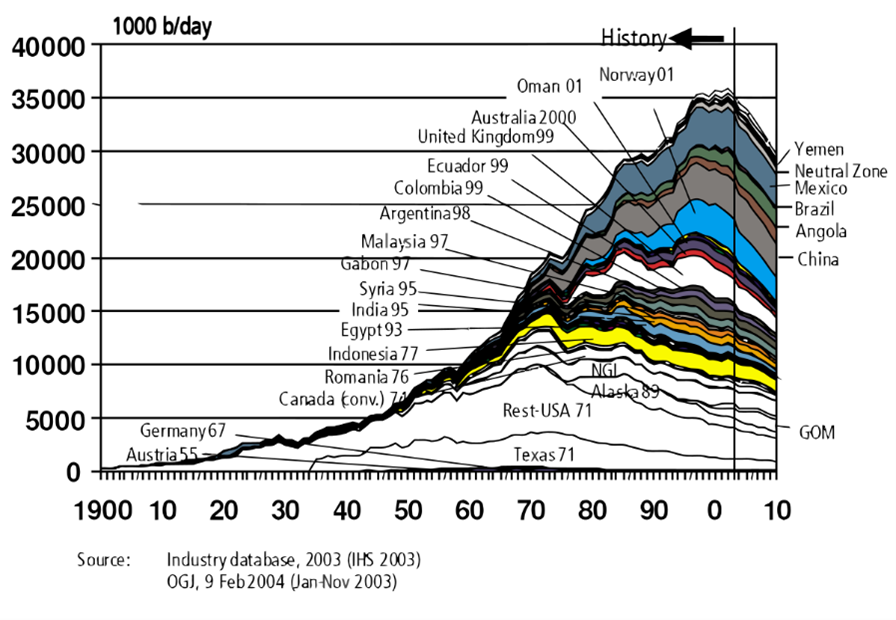
It also says that the factor limiting oil extraction is the energy required to extract it and not its cost. i.e., When you need to consume an energy equivalent to a barrel of oil or more to get that same barrel, production is not profitable and the site in question is abandoned.
We can get a bit more technical into fossil fuels. For instance, when fossil fuels are burnt, their carbon reacts with oxygen to form carbon dioxide. The energy originally provided by the Sun, stored in chemical bonds for millions of years, is released and the carbon returns to the air. A simple example is the burning of natural gas: one molecule of methane and two of oxygen combine to produce carbon dioxide and water.
CH₄ + 2 O₂ → CO₂ + 2 H₂O
Burning a kilogram of natural gas releases 15kWh of energy in the form of infrared radiation (radiant heat). This is a sizeable amount.
To stop continuously worsening climate change, we need to stop burning fossil fuels for energy. That’s a tall order, because fossil fuels provide 84% of all the energy used by human civilization.
There are many possible sources of renewable or low-carbon energy: nuclear, hydropower, wind, solar, geothermal, biomass (burning plants for energy) and biofuel (making liquid or gaseous fuels out of plants). A handful of tidal power stations are in operation, and experiments are under way with wave and ocean current generation. But, among these, the only two with the capacity to scale up to the staggering amount of energy we use are wind and solar. Despite impressive growth (doubling in less than five years), wind provides only 2.2% of all energy, and solar 1.1%. Renewables are inexhaustible natural sources. They are therefore much more respectful with the environment. Unlike with fossil fuels, non-polluting and represent the cleaner alternative to the use of them.
Photovoltaic energy is a source of energy that produces electricity from renewable sources. It is the direct transformation of solar radiation into direct current electricity. Solar radiation is captured by some semiconductor devices called photovoltaic cells, which have the property of absorbing photons of light and emit electrons. When these free electrons are conducted an electric current is obtained which is understood as electricity. Therefore, photovoltaic energy is a renewable energy because it comes from an inexhaustible source of energy, the Sun. It is also a clean, sustainable and free resource.
Wind energy is obtained from the wind. It is one of the oldest resources that mankind has used. Using wind energy managed to convert the energy produced by wind turbine blades thanks to the force of the wind into electrical energy, wind turbines convert the kinetic energy of the wind into mechanical energy. It is an inexhaustible source, that does not pollute, and contributes to sustainable development.
Nuclear energy is usually considered another non-renewable energy source. Although nuclear energy itself is a renewable energy source, the material used in nuclear power plants is not.
Nuclear energy harvests the powerful energy in the nucleus, or core, of an atom. Energy is released through nuclear fission, the process where the nucleus of an atom splits. Nuclear power plants are complex machines that can control nuclear fission to produce electricity. The material most often used in nuclear power plants is the element uranium. Although uranium is found in rocks all over the world, nuclear power plants usually use a very rare type of uranium, U-235. Uranium is a non-renewable resource. Nuclear energy is a popular way of generating electricity around the world. Nuclear power plants do not pollute the air or emit greenhouse gases. They can be built in rural or urban areas, and do not destroy the environment around them. However, nuclear energy is difficult to harvest. Nuclear power plants are very complicated to build and run. Many communities do not have the scientists and engineers to develop a safe and reliable nuclear energy program.
Biomass energy relies on biomass feedstocks—plants that are processed and burned to create electricity. Biomass feedstocks can include crops such as corn or soy, as well as wood. If people do not replant biomass feedstocks as fast as they use them, biomass energy becomes a non-renewable energy source.
These are just some examples of the multiple choices that we have in terms of renewable energy. But why is it so hard to make the transition over to renewables?
Fossil fuels allowed us to move away from relying on today’s solar flows, instead using concentrated solar energy stored over millions of years. Before we could make efficient use of solar flows, this seemed like a great idea. However, the advantages of fossil fuels come with a devastating downside. We now understand that the release of carbon dioxide (CO2) from burning fossil fuels is warming our planet faster than anything we have seen in the geological record. One of the greatest challenges facing humanity today is slowing this warming before it changes our world beyond recognition. In the 21st century the earth gets plenty of energy from the sun for all of us, even for our modern energy-intensive lives. The amount of solar energy that reaches habitable land is more than 1,000 times the amount of fossil fuel energy extracted globally per year. The problem is that this energy is diffuse. The sun that warms your face is definitely providing energy, but you need to concentrate that energy to heat your home or move a vehicle. This is where modern technology comes in. Wind turbines and solar photovoltaic (PV) cells convert solar energy flows into electricity, in a process much more efficient than burning biomass, the pre-industrial way of capturing solar energy. Costs for wind and solar PV have been dropping rapidly and they are now mainstream, cost-effective technologies. Some existing forms of generating electricity, mainly nuclear and hydroelectricity, also don’t result in CO2 emissions. Combining new renewables with these existing sources represents an opportunity to decarbonize — or eliminate CO2 emissions from — the electricity sector. However, unlike fossil fuels, wind and solar can only generate electricity when the wind is blowing, or the sun is shining. This is an engineering challenge, since the power grid operates in real time: Power is generated and consumed simultaneously, with generation varying to keep the system in balance.
Some problems arise from renewables, so they are not the perfect replacement yet “Electrify everything” is a great plan, so far as it goes, but not everything can be easily electrified. Certain qualities of fossil fuels are difficult to replicate, such as their energy density and their ability to provide very high heat. To decarbonize processes that rely on these qualities, you need low-carbon fuels that mimic the qualities of fossil fuels.
For example, fossil fuels are particularly important in the transportation sector. A vehicle needs to carry its fuel around as it travels, so the weight and volume of that fuel are key. Electric vehicles are a much-touted solution for replacing oil, but they are not perfect for all uses. Pound for pound, gasoline or diesel fuel contain about 40 times as much energy as a state-of-the-art battery. On the other hand, electric motors are much more efficient than internal combustion engines and electric vehicles are simpler mechanically, with many fewer moving parts.
Industrial processes that need very high heat — such as the production of steel, cement, and glass — pose another challenge. Steel blast furnaces operate at about 1,100° C, and cement kilns operate at about 1,400° C. These very high temperatures are hard to achieve without burning a fuel and are thus difficult to power with electricity.
Renewable electricity can’t solve the emissions problem for processes that can’t run on electricity. For these processes, the world needs zero-carbon fuels that mimic the properties of fossil fuels —energy-dense fuels that can be burned. A number of options exist, but they each have pros and cons and generally need more work to be commercially and environmentally viable.
Biofuels are a possibility, since the carbon released when the biofuel is burned is the same carbon taken up as the plant grew. However, the processing required to turn plants into usable fuels consumes energy, and this results in CO2 emissions, meaning that biofuels are not zero-carbon unless the entire process runs on renewable or zero-carbon energy. For example, the corn ethanol blended into gasoline in the United States averages only 39% lower CO2 emissions than the gasoline it replaces, given the emissions that occur from transporting the corn to processing facilities and converting it to fuel.
Another pathway is to convert renewable electricity into a combustible fuel. Hydrogen can be produced by using renewable electricity to split water atoms into their hydrogen and oxygen components. The hydrogen could then be burned as a zero-carbon fuel, similar to the way natural gas is used today. Electricity, CO2, and hydrogen could be also combined to produce liquid fuels to replace diesel and jet fuel. However, when we split water atoms or create liquid fuels from scratch, the laws of thermodynamics are not in our favor.
So in short there is no one solution to the problem of Fossil fuels or Renewable energy. Fossil fuels will be needed for some time in certain sectors. Eliminating unpopular energy sources or technologies, like nuclear or carbon capture, from the conversation is short-sighted. Renewable electricity generation alone won’t get us there — this is an all-technologies-on-deck problem.